Pasco's Trusted Marine Contractors  |  Call Now: (727) 597-5782
📞 (727) 597-5782
★★★★★ 5.0 Customer Rating
Fully Insured
Free Quotes
Locally Owned & Experienced
Homeowner Guide

Storm Seawall Checklist: What to Check After a Storm

What to photograph, what to look for from the yard and from the water, and which storm repairs play by their own rules.

Free Quotes
Fully Insured
Local Specialists

Quick answer

This storm seawall checklist covers the damage a hurricane leaves on the Pasco and north Pinellas coast: soil washing out behind the cap, panels leaning toward the water, and docks or lifts knocked off their pilings. Photograph it all before anyone cleans up, and keep people off the wall. Then check the storm exemptions.

What Helene, Idalia and Milton did on this coast

Three storms in fourteen months tested walls from Hernando Beach to Safety Harbor. The National Hurricane Center's Helene report puts storm surge at 6 to 9 feet above ground along the Nature Coast down to the Anclote River, and 5 to 7 feet from the Anclote south. A USGS sensor in Pasco County measured 7.60 feet above mean higher high water, one at Fred Howard Park read 7.23 feet, and the Clearwater tide gauge set a station record at 6.67 feet, passing the March 1993 Superstorm. NHC counts at least 9,900 damaged structures in Pasco, most of them from surge along the coast.

Idalia in August 2023 brought 3 to 5 feet of inundation along the coast from Chassahowitzka south. Milton in October 2024 made landfall well to the south, and offshore winds held surge north of landfall to 1 to 2 feet. A storm seawall checklist needs a second pass, because damage doesn't always show up on day one. Fill can wash out through open joints and leave a void under the yard that caves in weeks later. Walk the wall again after the next few high tides.

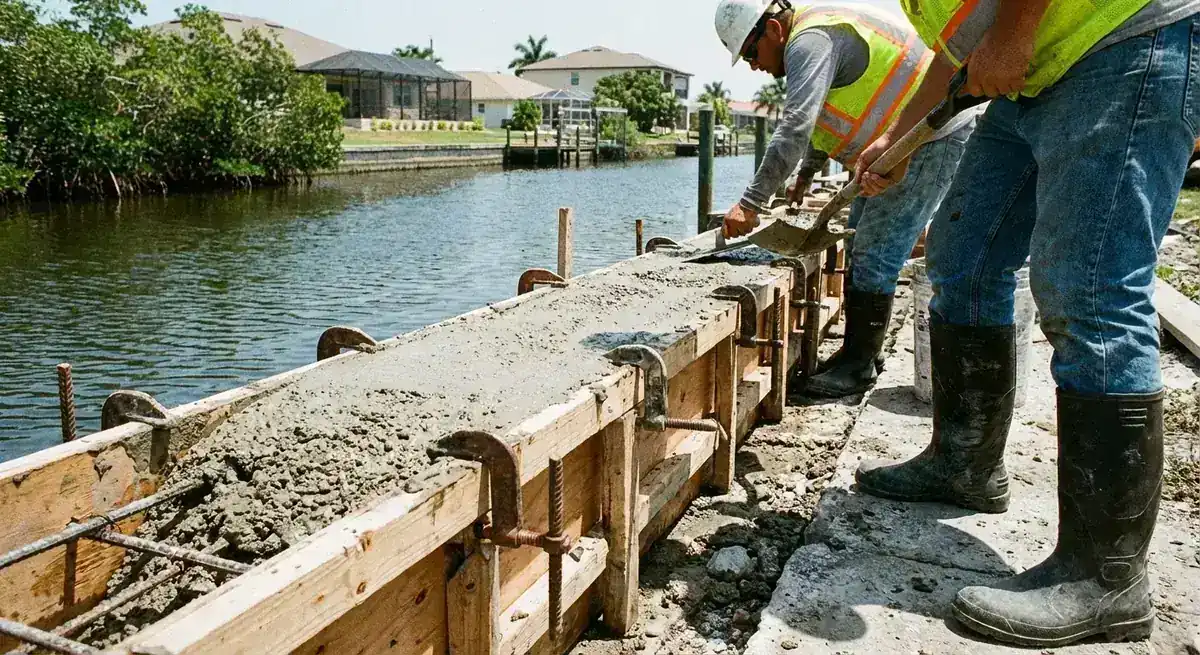
Workers shoveling fresh concrete into a seawall cap form with clamps along a canal

Storm seawall checklist: first steps before anyone cleans up

  • Stay off the cap and the dock until someone has looked them over. A cap can look perfectly fine sitting over an empty cavity.
  • Kill power to the lift and dock at the breaker before touching anything that was under water.
  • Photograph everything with the date showing: the wall from both ends, the cap, the yard behind it, the dock from the water side, and any debris in the canal.
  • Mark sinks and holes with stakes or cones so nobody steps or drives a mower into them.
  • Write down what moved. Measure how far the top of the wall sits out of line at a few spots. Note any boards, pilings or lift parts that are gone.
  • Keep receipts for anything you pay for, including emergency debris removal.

In Pasco, County Code Sec. 114-52 says debris from a failed seawall or dock must be removed immediately, so once it's safe, pull floating boards and lumber out of the canal.

Our typical ranges for the repairs a storm seawall checklist turns up on walls, docks and lifts. Each becomes a fixed price on your written estimate.

RepairOur typical rangeUnit
Seawall joint, crack and void repair$100 to $300per LF of affected wall
Structural seawall repair$400 to $700per LF of affected wall
Seawall cap replacement$200 to $600per LF
Rip-rap at the toe$150 to $400per LF
Dock pile replacement$2,000 to $3,500per pile
Redeck or reframe a 30 to 40 ft dock$10,000 to $15,000per dock
Same-footprint dock rebuild$25,000 to $50,000per dock
Boat lift reset onto existing pilings$12,000 to $18,000per lift
Lift electrical$3,000 to $5,000own permit

We give a free written estimate after we see the damage. Lifts of 20,000 lb and up, and aluminum or steel walls, are quoted on site.

The storm seawall checklist from the yard and from the water

From the yard:

  • Soil dropped or washed away right behind the cap, or new holes farther back over the tiebacks.
  • Cracks along the cap, or a cap that has tipped toward the water.
  • Pavers, a shed or fence posts near the wall that have sunk or shifted.

From a boat or the neighbor's dock:

  • Panels leaning out at the top, or joints wider at the top than at the bottom.
  • Sand or fill bleeding out through joints or weep holes.
  • Bottom scoured away at the toe, or rip-rap that has rolled out of place.
  • Rust stains or exposed steel at the cap or tieback ends.

Spot any one item on this storm seawall checklist and it's worth having someone look. Several together, along a good stretch of the run, point toward structural repair or a new wall. The repair vs replacement cost guide shows how that decision gets priced.

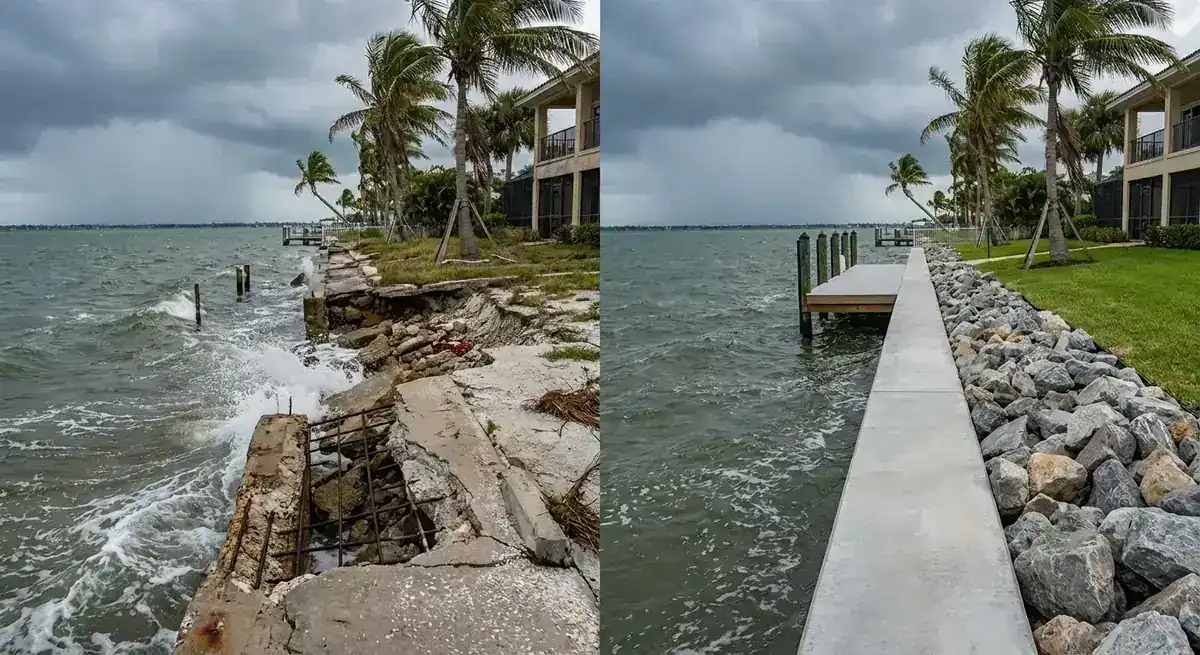
Before and after of a broken seawall replaced with a new concrete cap and rip-rap

Dock and boat lift walk-through

The storm seawall checklist doesn't stop at the cap. Walk the dock and the lift the same way:

  • Pilings: leaning, loose in the bottom, cracked, or cut through at the waterline.
  • Frame: stringers and caps split, sagging or pulled off the pilings. Missing deck boards are the easy part. The frame is what decides redeck or rebuild.
  • Hardware: bolts and brackets bent, sheared or missing.
  • Floating docks: floats cracked or out of their frames.
  • Boat lift: cables frayed or kinked, beams twisted, cradle bunks broken, motors and switches that were under water. Leave the power off until an electrician has checked it.
  • Canopy: torn fabric or bent frame. In Pasco, LDC 1001.6 requires lift canopies to be removed and stored indoors when officials warn of a storm, so have a plan for that before the next one.

Our dock repair page and boat lift page walk through what each fix involves.

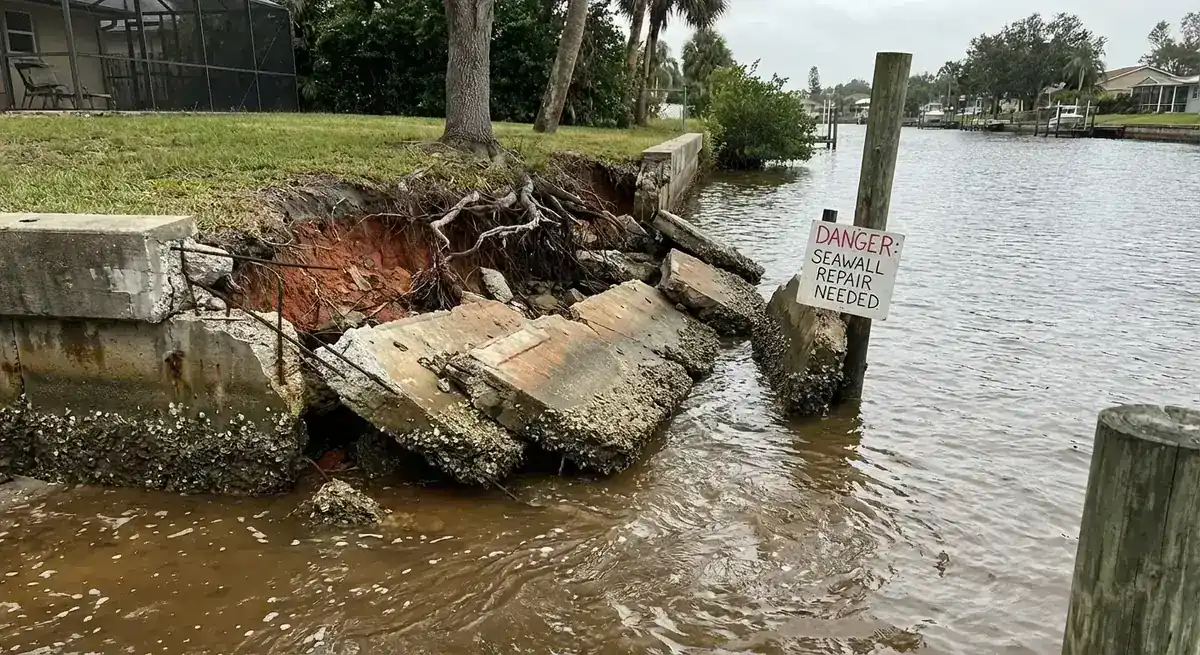
Collapsed concrete seawall panels and eroded yard soil along a residential canal

Storm repairs that get a lighter permit path

Storm damage opens a few doors that everyday repairs don't get. Each one comes with limits.

State (DEP). Rule 62-330.051 exempts restoring a seawall no more than 18 inches waterward of its old face when a storm, flood, accident or fire damaged it within the last year. The dock repair exemption likewise covers a dock made non-functional by a storm within the last year, rebuilt within 5 feet of the same spot and no larger. Let a year go by and the storm-damage route closes.

Pinellas. Under Code Sec. 58-507, after a natural disaster the county may invoke an exemption letting owners or their contractors repair or replace storm-damaged docks to the prior permitted shape without a Water and Navigation permit, with 48-hour advance notice. Replacement seawalls more than one foot out front, plus emergency dredging, still need a dredge and fill permit, expedited and fee-waived. Outside that exemption, Sec. 58-544 says repairing a permitted lift needs no Water and Navigation permit unless pilings are replaced, and swapping deck boards alone needs none.

Pasco. Sec. 18-36 still requires a permit for any dock or seawall repair. Under LDC Sec. 1001.5.F, a nonconforming dock damaged past the county's flood-code damage threshold can only come back built to current rules.

City storm rules in Tarpon Springs, Oldsmar, Safety Harbor and Dunedin

Some cities stack their own storm paperwork on top of the county's.

Tarpon Springs mailed Storm Damage Permit Requirement Letters to homes in the flood zone it believed were damaged by Debby, Helene or Milton without a permit. The city's hurricane permit page gives owners 60 days to contact the Building Department, and after-the-fact storm permits carry no penalty beyond the storm damage permit fee. Starting October 1, 2026, the city also requires a separate floodplain permit for new construction and additions in a flood zone.

Oldsmar keeps a Post-Storm Permitting Guide on its website. If you're replacing a damaged dock piling there, the old one has to come out entirely, below the waterline too.

Safety Harbor runs its 49% rule review on improvements and damage to flood-zone structures before a permit goes to Pinellas County.

Dunedin requires a covered boat dock damaged by fire or hurricane to be repaired, replaced or removed within 180 days.

Live in one of these cities? Call the city desk before you put anything on the schedule. Our Oldsmar page covers the Old Tampa Bay side.

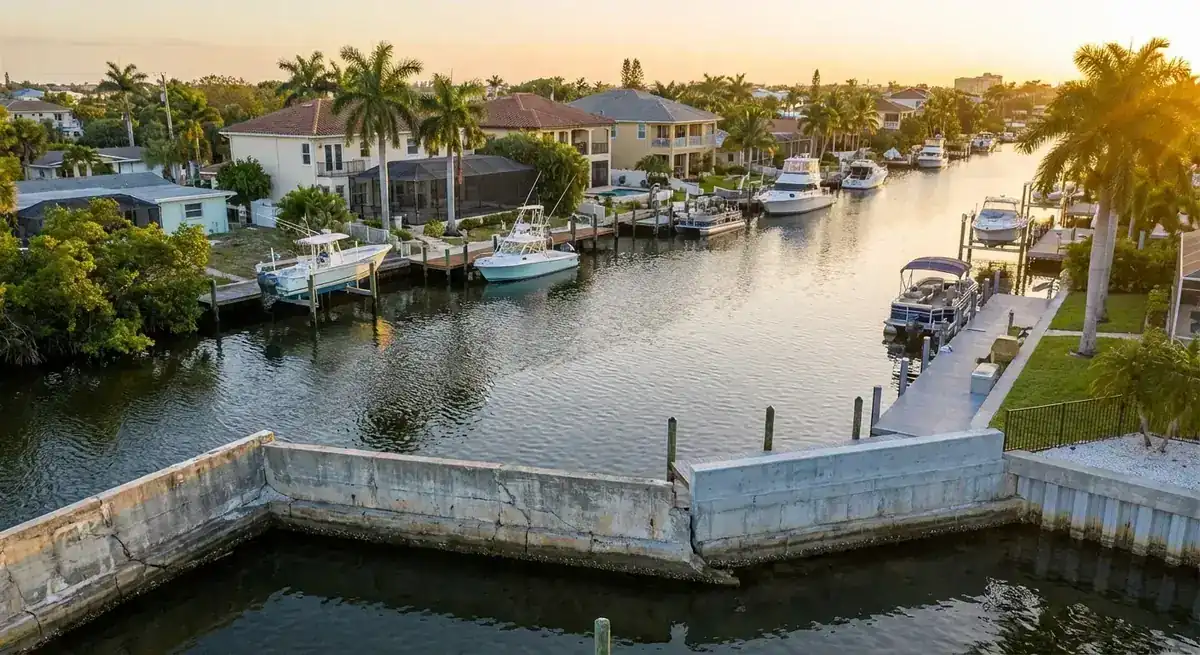
Aerial view at sunset of an aging cracked concrete seawall along a residential canal with docks

Hiring after a storm without getting burned

Demand jumps after a storm, and so does the paperwork risk. Florida and the counties wrote a few protections into law:

  • Notice of Commencement. Florida Statute 713.13 requires the owner to record one before work starts on any job over $2,500. It is void if work does not start within 90 days, and payments after it expires can mean paying twice.
  • Deposits in Pasco. County Code Sec. 18-79 says a contractor who takes more than 10% up front on residential work must apply for permits within 30 days and start within 90 days of issue, unless you agree in writing to longer.
  • Insurance on the water. Pinellas Sec. 58-510 requires contractors working on docks and walls to carry Longshore and Harbor Workers' and Jones Act coverage. Pasco requires workers' compensation under class code 6006F for anyone working on the water.
  • Old pilings. In Pinellas, CCA-treated dock pilings go to a permitted landfill by appointment, cut to 4 feet or less, with a $110 special handling fee per load. Ask who's hauling them and where they're going.

Get a written scope that breaks out the wall, the dock and the lift. That way you can match each line to your photos and to your insurer's estimate. Hand the contractor your storm seawall checklist notes so the scope covers everything you wrote down.

Getting the wall ready for the next one

The storm record that helps you most is the one you take before the storm, so keep a copy of this storm seawall checklist with your survey and permits. Photograph the wall, cap, dock and lift each spring, from the same spots, so damage is easy to prove later. Keep your survey, old permits and any engineering together in one folder. Look up your lot on FEMA's flood map; base flood elevations on this coast vary block by block: 10 feet NAVD88 at most mapped points in Gulf Harbors, 11 feet the most common in Port Richey, and up to 15 feet at VE points on the Hudson Gulf front.

If your wall already has small problems, fix them while they're still small. Non-structural repair runs $100 to $300 per foot of affected wall; structural repair runs $400 to $700. A stand-alone seawall inspection is $250 to $500 per visit if you want a written report on file. In Pasco, take the lift canopy down when officials issue a storm warning, as LDC 1001.6 requires.

Once the wall is past saving, replacement gives you a chance to rethink the cap height and the toe protection. The vinyl vs concrete seawall guide and the seawall repair and construction page cover those choices.

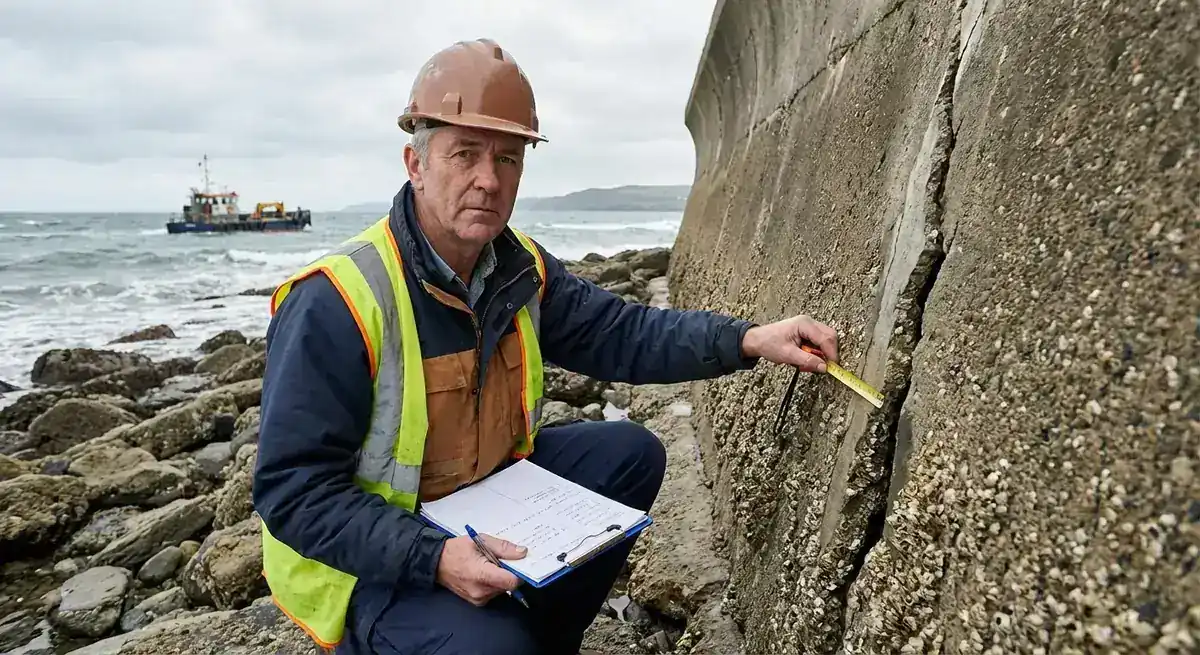
Inspector measuring a vertical crack in a barnacle covered concrete seawall on a rocky shore

Frequently Asked Questions

What belongs on a storm seawall checklist?
Start with safety: stay off the cap, kill power to the lift and photograph everything with the date showing. Then check the yard behind the wall for sinks, the panels and joints from the water, the dock pilings and frame, and the lift cables and motor. Write down what moved and keep every receipt.
How soon after a storm should a seawall be checked?
As soon as it's safe, and well inside a year. DEP's storm exemptions for restoring a seawall within 18 inches of its old face, or rebuilding a storm-damaged dock, only cover damage from the last year. Fill can keep washing out through open joints after the water drops, so the sooner you fix it, the smaller the repair.
Can I rebuild a storm-damaged dock exactly as it was?
Yes, with some limits. DEP's exemption allows rebuilding within 5 feet of the same spot and no larger if the dock was knocked out by a storm in the last year, and when Pinellas invokes its post-disaster exemption, a permitted dock can come back in its prior configuration. In Pasco, a nonconforming dock damaged past the flood-code threshold must be rebuilt to current rules.
Does Pinellas County waive dock permits after a hurricane?
Only when the county invokes the Sec. 58-507 exemption after a natural disaster. Then owners or their contractors can restore storm-damaged docks to the prior permitted shape with 48 hours' notice instead of a Water and Navigation permit. A replacement seawall more than one foot out front still needs an expedited, fee-waived dredge and fill permit.
Who has to clean up a collapsed seawall in Pasco?
The owner. Pasco County Code Sec. 114-52 requires debris from a failed seawall, bulkhead or dock to be removed immediately, and makes owners repair or replace walls that are structurally unsound or out of position. Take your photos first, then clear what you safely can from the canal.
What do I do with broken CCA dock pilings in Pinellas?
Pinellas County takes CCA-treated pilings at a permitted landfill by appointment with 48 hours' notice. They must be cut to 4 feet or less, loaded by themselves, and free of hardware and decking, and there is a $110 special handling fee per load on top of disposal. The county's docks page explains the steps.
I got a storm damage permit letter from Tarpon Springs. What now?
The letter asks you to contact the Building Department within 60 days about work done after Debby, Helene or Milton without a permit. The city says after-the-fact storm damage permits carry no penalty beyond the storm damage permit fee, so answer it instead of sitting on it.
Does my boat lift canopy have to come down before a storm in Pasco?
Yes. Pasco LDC 1001.6 requires lift canopies to be removed and stored indoors when officials tell the public to secure loose items before a storm. Canopies are also limited to vertical and cantilever lifts, one per property, open-sided and in neutral colors.
What does storm repair to a seawall cost?
That depends on how many feet failed and how. In our typical ranges, joint and void repair runs $100 to $300 per foot of affected wall, structural repair $400 to $700 per foot, a new cap $200 to $600 per foot, and a new vinyl wall with a cap $450 to $700. An 80 ft replacement at that range is $36,000 to $56,000.

Get Your Free Marine Construction Estimate

Tell us about your seawall, dock, or shoreline project and we’ll follow up with a practical next step and a no-obligation estimate.

  • 100% free, no-obligation estimates
  • Responsive follow-up from a local marine contractor
  • Support for seawall, dock, and shoreline projects
  • Clear project scoping and transparent pricing
  • Experienced crews for challenging waterfront conditions

Request a Free Quote

Fill out the form below and we’ll contact you shortly.

Page updated

Need Help Protecting Your Waterfront Property?

Talk with Pasco's trusted marine contractors about seawall repair, dock work, or a full waterfront construction project.

📞 Call (727) 597-5782 Request Quote Online
📞 Call Now Get Quote