Pasco's Trusted Marine Contractors  |  Call Now: (727) 597-5782
📞 (727) 597-5782
★★★★★ 5.0 Customer Rating
Fully Insured
Free Quotes
Locally Owned & Experienced
Homeowner Guide

Vinyl vs Concrete Seawall on the Gulf Coast

What's really in each wall, where local code makes the call for you, and what each runs per foot on our canals.

Free Quotes
Fully Insured
Local Specialists

Quick answer

The vinyl vs concrete seawall choice on the Pasco and north Pinellas coast is partly made by code: Pinellas County requires concrete sheet pile on Gulf of Mexico frontage. On canals it's your pick, and the prices sit close together: vinyl with a concrete cap runs $450 to $700 per foot, concrete $500 to $900.

Vinyl vs concrete seawall: what each wall is made of

Here's the first thing to know: neither wall is just one material. A concrete wall here is a row of reinforced sheet piles or panels driven into the bottom, tied back to anchors in the yard with steel rods, and locked together by a poured cap. A vinyl seawall trades the concrete sheets for interlocking vinyl sheet piles. It still gets a poured cap and tiebacks behind it. That's how we quote our vinyl range, too: vinyl sheet pile plus concrete cap, per linear foot.

Why does that matter? A vinyl sheet has no rebar inside it to rust, but the cap above it and the tieback steel behind it do have steel, so both wall types live or die partly on how well that steel is protected. Comparing quotes? Ask about tieback size, spacing, length and coating, and the cap dimensions. Don't stop at the sheet material. Our construction page covers how a wall goes in.

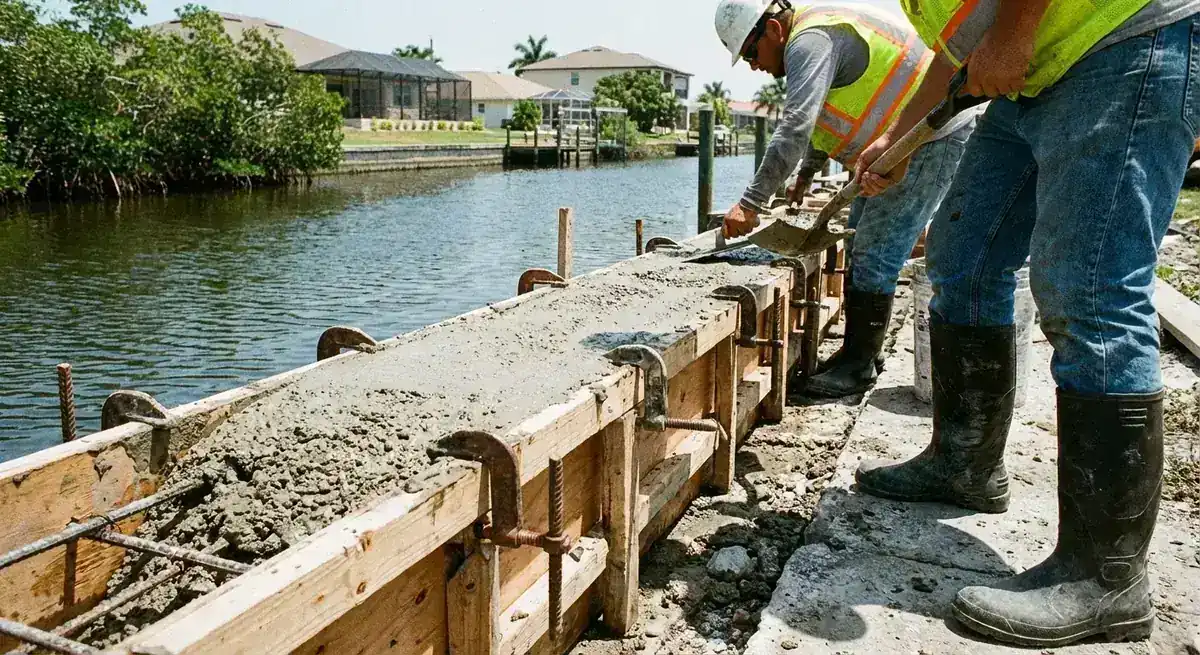
Workers shoveling fresh concrete into a seawall cap form with clamps along a canal

Where local code chooses the material for you

Before you get into pros and cons, check whether your shoreline already has an answer.

  • Pinellas Gulf frontage. Pinellas Code Sec. 58-577 says walls on the Gulf of Mexico must be masonry: concrete sheet pile 7.5 inches thick, epoxy-coated reinforcing, a cap at least 12 inches thick and 18 inches wide, and tie rods at least 16 feet long. Inside city limits, Sec. 58-511 leaves construction standards and the wall's building permit to the city.
  • Other Pinellas water. Sec. 58-576 writes design criteria for concrete, aluminum and wood walls. Aluminum walls are capped at 5 feet of exposed height.
  • Dunedin. The city's seawall section accepts reinforced concrete, structural marine-grade aluminum or preservative-treated wood, and rules out asbestos cement and steel. Every wall needs weep holes, geotextile fabric, select backfill and anchored tiebacks.
  • Unincorporated Pasco. No material list, but signed and sealed construction plans are required for any seawall permit.
  • Hernando Beach. Engineered plans, and riprap facing the footer of every permitted wall.

If your city or county code names materials and vinyl isn't on the list, ask that permit desk how it handles an engineered vinyl design before you settle on one. The permit guide lists each desk.

Our typical ranges for new and replacement seawalls on Pasco and north Pinellas water.

WallOur typical rangeUnitNotes
Vinyl sheet pile with concrete cap$450 to $700per LFTypical 60 to 100 LF canal lot: $30,000 to $65,000
Concrete seawall$500 to $900per LFRequired on Pinellas Gulf frontage
Rip-rap at the toe$150 to $400per LFRequired on Hernando walls; may be required in Pinellas
Aluminum or steelQuoted on siteDunedin rules out steel

Each range turns into a fixed price on your free written estimate after we see the wall, the access and the soil.

Canal fill, salt and the steel inside a wall

USDA soil survey data (SSURGO, served through FDEP Map Direct) rates how hard each soil is on buried concrete and uncoated steel. Along this coast the ratings change block by block:

  • Udalfic Arents-Urban land complex, the fill mapped in parts of the Pasco canal communities: High for concrete corrosion, Low for steel.
  • Homosassa mucky fine sandy loam, a tidal soil in the Pasco coastal strip west of U.S. 19: High for both concrete and steel.
  • Aripeka fine sand: Moderate for concrete, High for steel.
  • Myakka soils and Urban land in north Pinellas: High for both. Matlacha and St. Augustine fill: Low for concrete, High for steel.

Treat that list like a spec sheet. On fill rated High for concrete, a wall's cover over its rebar earns its keep; Pinellas Sec. 58-576 already asks for 2 inches. On soils rated High for steel, the tiebacks and anchors in the yard matter on either wall type, which is why Pinellas wants epoxy-coated steel on Gulf-front walls. Pull up your own lot on the soil map before you choose.

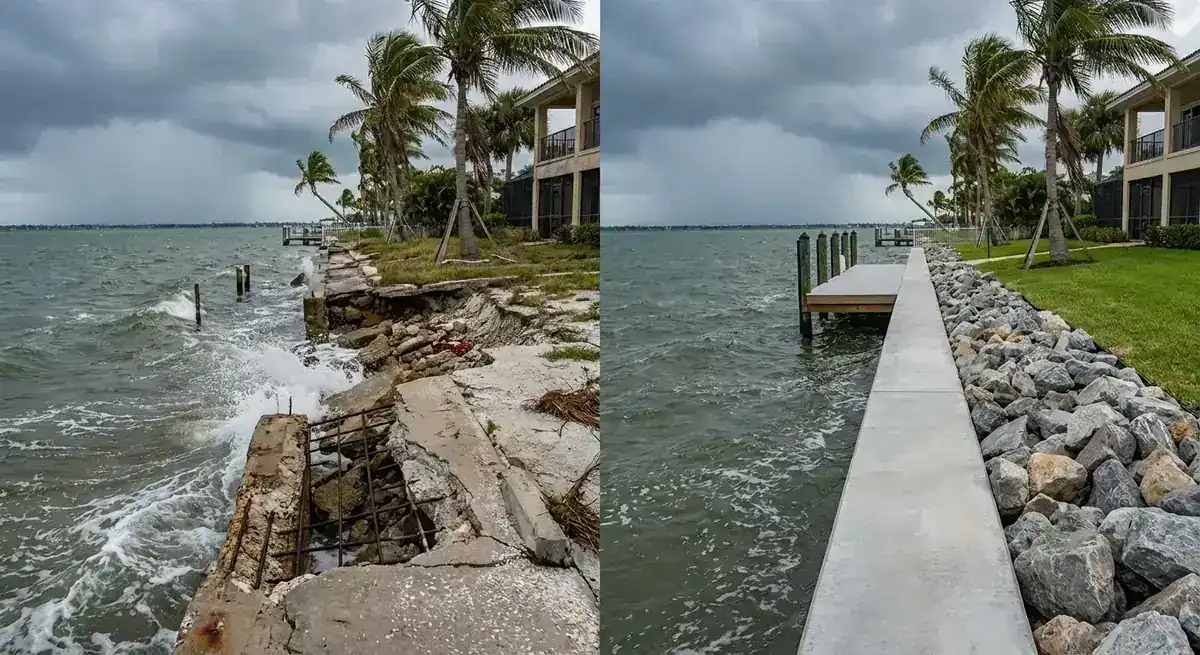
Before and after of a broken seawall replaced with a new concrete cap and rip-rap

Pinellas concrete wall minimums at a glance

ItemNon-Gulf water (Sec. 58-576)Gulf of Mexico (Sec. 58-577)
Concrete strength3,500 psi, 2 inches of cover3,500 psi, 2-1/2 inches of cover, all steel epoxy-coated
Sheet pile thickness5-5/8 inches or more7.5 inches
Poured cap9-1/2 inches thick, 16 inches wide, four #4 bars12 inches thick, 18 inches wide, four #5 epoxy-coated bars
Tiebacks#8 bar or larger, 12 ft or longer, no more than 10 ft apart#9 bar or larger, 16 ft or longer, no more than 10 ft apart, cased in concrete
EmbedmentGreater of 0.67 x exposed height or 0.4 x slab length, 8 ft minimumHalf the slab length or more, 12 ft minimum slab
Expansion jointsEvery 40 ft, normallyEvery 40 ft, normally
Minimum wall elevationBay-front walls: 5 ft (USCGS datum)Gulf-front walls: 6 ft (USCGS datum)

Those are code floors for Pinellas walls, not a design. Your engineer sizes the actual wall for your height of fill and your water depth.

Price per foot, side by side

Our two ranges overlap, so a vinyl vs concrete seawall quote rarely turns on price alone. A new vinyl wall with a concrete cap runs $450 to $700 per linear foot. A full concrete wall runs $500 to $900 per foot. On an 80 foot canal lot that works out to:

  • Vinyl with concrete cap: 80 LF x $450 to $700 = $36,000 to $56,000.
  • Concrete: 80 LF x $500 to $900 = $40,000 to $72,000.

Want a local gut check? Recent new concrete wall permits in the Hudson area ran $37,000 to $57,000. On Pinellas Gulf frontage, the Sec. 58-577 spec puts thicker sheets, a bigger cap and longer, heavier tie rods into every foot of wall, so a Gulf-front wall carries more concrete and steel per foot than a canal wall does.

Things that push either number up or down: total length, the exposed height of the wall, how many returns tie into the neighbors, whether the old wall comes out or stays behind the new face, rip-rap at the toe ($150 to $400 per foot), and whether a dock or lift has to come off and go back. Aluminum and steel walls are quoted on site only. If your wall may only need a fix, start with the repair vs replacement cost guide.

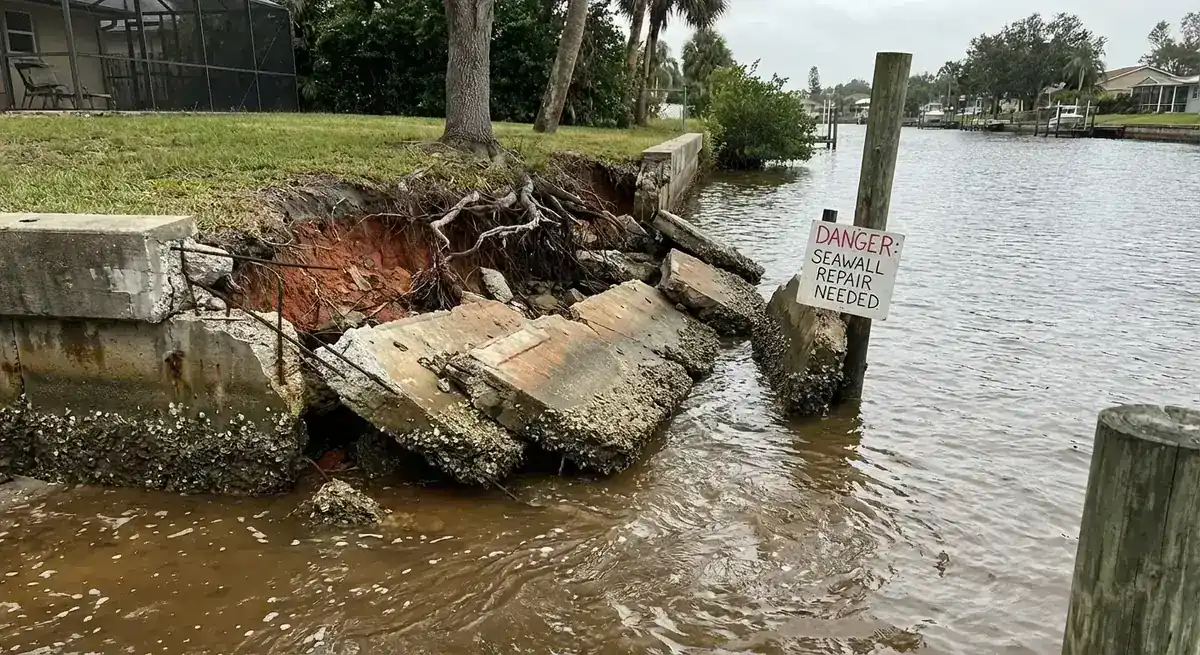
Collapsed concrete seawall panels and eroded yard soil along a residential canal

Cap height, surge and the wall you pour now

In any vinyl vs concrete seawall choice, the cap height is the decision you'll live with longest. Hurricane Helene in September 2024 pushed the Clearwater tide gauge to 6.67 feet above mean higher high water, a record for that station, and a USGS sensor in Pasco County read 7.60 feet. NOAA puts the relative sea level trend at Clearwater Beach at 1.72 inches per decade.

Written floors exist nearby. Pinellas wants bay-front concrete walls at elevation 5 feet or higher and Gulf-front walls at 6 feet, and Clearwater's code requires walls on Clearwater Harbor and the Gulf to stand at least six feet above mean sea level. Anywhere else, ask your permit desk what applies before you settle on a cap height.

Height also changes what the wall is holding back. Go taller and it carries more fill. That means longer sheets, deeper embedment and heavier tiebacks on either material, and you'll see it in the per foot price.

Lakes and natural shorelines play by different rules

Lake Tarpon, Lake Keystone and the Odessa lakes take salt out of the picture. What they add instead are environmental limits that can matter more than the material. Pinellas Code Secs. 58-573 and 58-575 call for riprap instead of a seawall where possible and plants instead of hardening wherever possible, bar walls on shorelines that generally support wetland vegetation, and approve a new wall only when no other option is reasonable. Pasco prohibits a new seawall in a Category I wetland. In Hillsborough, a seawall built along a lake keeps the 30 and 50 foot wetland setbacks behind it.

On a lot like that, your real choice may be fixing the wall you've got or switching to rip-rap, not a vinyl vs concrete seawall decision. Our Palm Harbor page and Keystone page cover the lake rules that apply there.

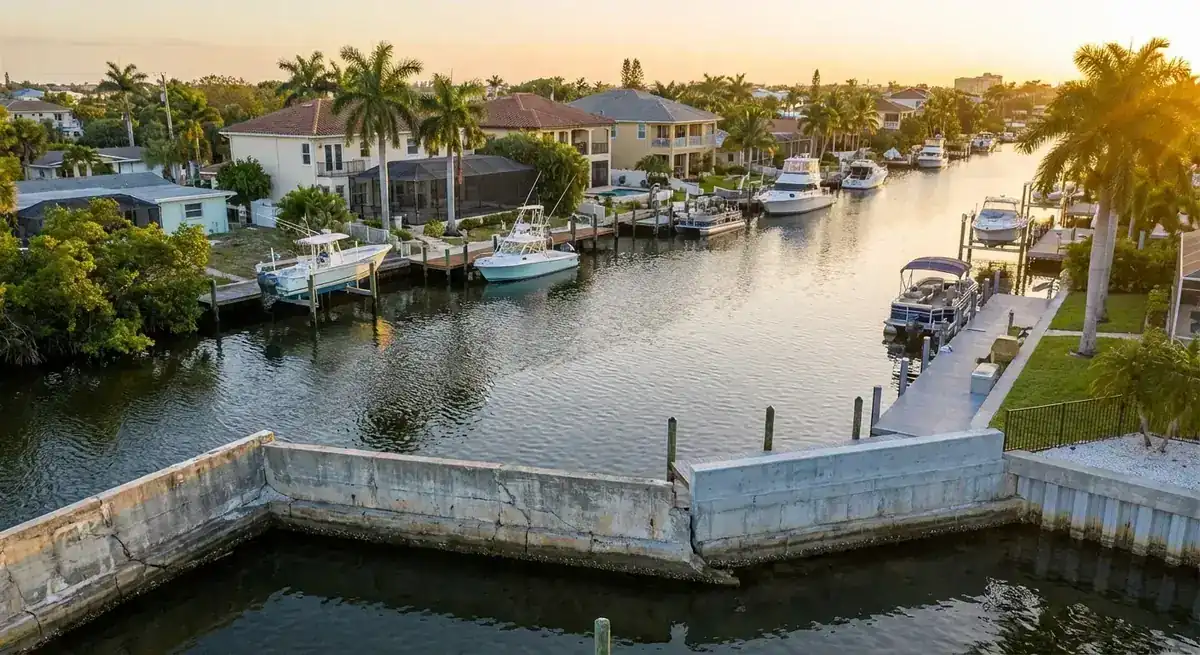
Aerial view at sunset of an aging cracked concrete seawall along a residential canal with docks

Reading two quotes line by line

Two quotes for the same lot can look far apart and still describe the same job. Lay them side by side and check these lines before you look at either total:

  • Linear footage priced, and whether the returns at each property line are counted.
  • Exposed wall height and the finished cap elevation.
  • Tieback size, length, spacing and coating, and how many anchors the yard needs.
  • Cap width and thickness, and the steel inside it.
  • Whether the old wall is pulled out or left in place behind the new face.
  • Rock at the toe, and who supplies the stone.
  • Who draws the engineered plans and who pulls the permits.
  • What happens to a dock, lift or fence that touches the wall.

A quote that skips one of these lines is not cheaper, it is unfinished. Ask the contractor to add the line instead of guessing at its price. We break each one out on a free written estimate, so you can compare ours to anyone else's item by item and see where a gap between two totals really comes from.

Five questions to answer before you choose

  1. Does your county or city code name wall materials for your shoreline? If yes, start there.
  2. What does the soil map say about concrete and steel corrosion at your address?
  3. How tall will the new cap be, and how much fill will the wall hold back?
  4. Can a crew reach the wall from the yard, or only from the water?
  5. What does the engineer's tieback and cap design look like for each option?

Bring those answers to your free on-site assessment, and we'll price your vinyl vs concrete seawall options side by side on one written estimate.

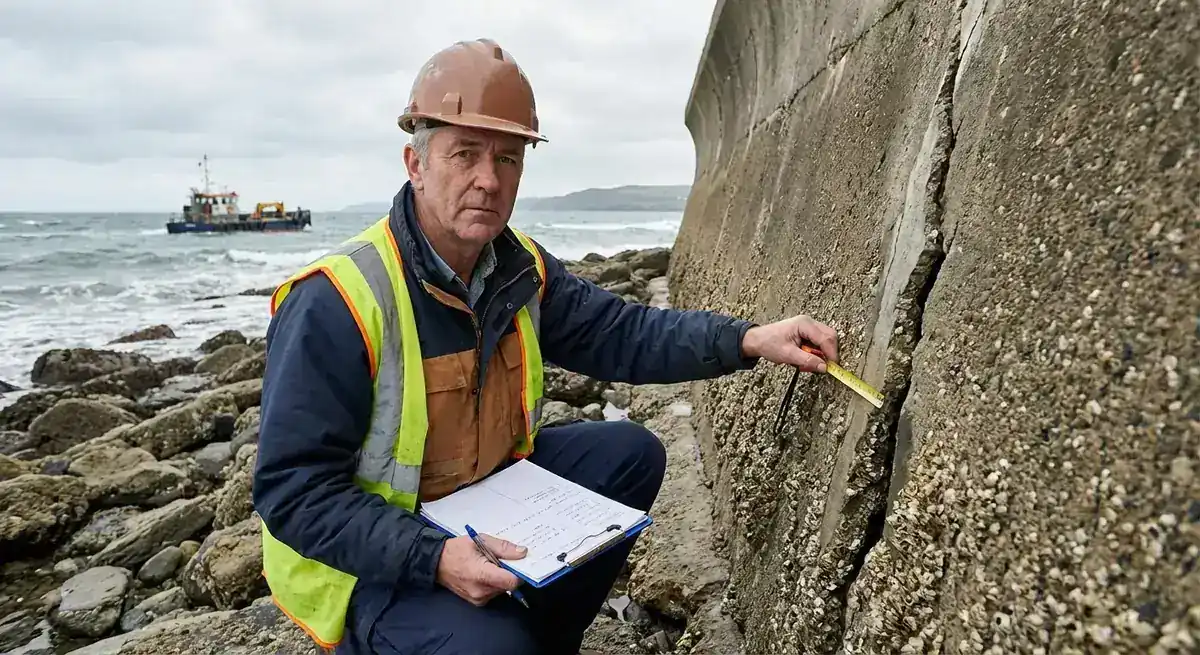
Inspector measuring a vertical crack in a barnacle covered concrete seawall on a rocky shore

Frequently Asked Questions

Can I put a vinyl wall on Gulf-front property in Pinellas County?
Pinellas Code Sec. 58-577 sets the standard for walls on the Gulf of Mexico as concrete sheet pile 7.5 inches thick with epoxy-coated reinforcing, a cap at least 12 by 18 inches and tie rods at least 16 feet long. If your lot fronts the open Gulf, plan on concrete and confirm it with the building desk that issues your wall permit, since cities set their own construction standards.
In a vinyl vs concrete seawall comparison, which costs less?
A little, not a lot, going by our ranges. Our vinyl range is $450 to $700 per foot including the concrete cap; concrete runs $500 to $900. On an 80 foot lot that is $36,000 to $56,000 against $40,000 to $72,000. Access, wall height and tiebacks can close that gap.
Does a vinyl seawall still need a concrete cap and tiebacks?
Yes. Our vinyl price is quoted as sheet pile plus a poured cap, and the wall is tied back to anchors in the yard. Dunedin's code, for one, requires anchored tiebacks on every seawall. On a vinyl wall, that cap and tieback steel is where corrosion protection counts.
Does Dunedin allow vinyl walls?
Dunedin's seawall section lists reinforced concrete, structural marine-grade aluminum and preservative-treated wood as acceptable, and rules out asbestos cement and steel. Vinyl isn't named. Before you commit, ask the city's zoning administrator how they'd review an engineered vinyl design.
Which lasts longer, a vinyl or a concrete seawall?
There's no single answer, because it comes down to what fails first: on a concrete wall, the rebar inside the panels and cap; on a vinyl wall, the tiebacks, hardware and cap. Check your soil's corrosion ratings, then compare the cover, coating and tieback specs in each quote.
What concrete strength does Pinellas require for a seawall?
Sec. 58-576 sets 3,500 psi concrete with 2 inches of cover over the steel, sheet piles at least 5-5/8 inches thick, and a poured cap at least 9-1/2 inches thick and 16 inches wide with four #4 bars. Gulf-front walls under Sec. 58-577 go heavier.
Should a lake lot get vinyl or concrete?
Start with the shoreline rules. Pinellas prefers riprap or plants on lakes like Lake Tarpon and bars new walls on shorelines with wetland vegetation, Pasco bans new seawalls in Category I wetlands, and Hillsborough keeps setbacks behind lake walls in Keystone. If a wall is allowed, the same price ranges apply.

Get Your Free Marine Construction Estimate

Tell us about your seawall, dock, or shoreline project and we’ll follow up with a practical next step and a no-obligation estimate.

  • 100% free, no-obligation estimates
  • Responsive follow-up from a local marine contractor
  • Support for seawall, dock, and shoreline projects
  • Clear project scoping and transparent pricing
  • Experienced crews for challenging waterfront conditions

Request a Free Quote

Fill out the form below and we’ll contact you shortly.

Page updated

Need Help Protecting Your Waterfront Property?

Talk with Pasco's trusted marine contractors about seawall repair, dock work, or a full waterfront construction project.

📞 Call (727) 597-5782 Request Quote Online
📞 Call Now Get Quote